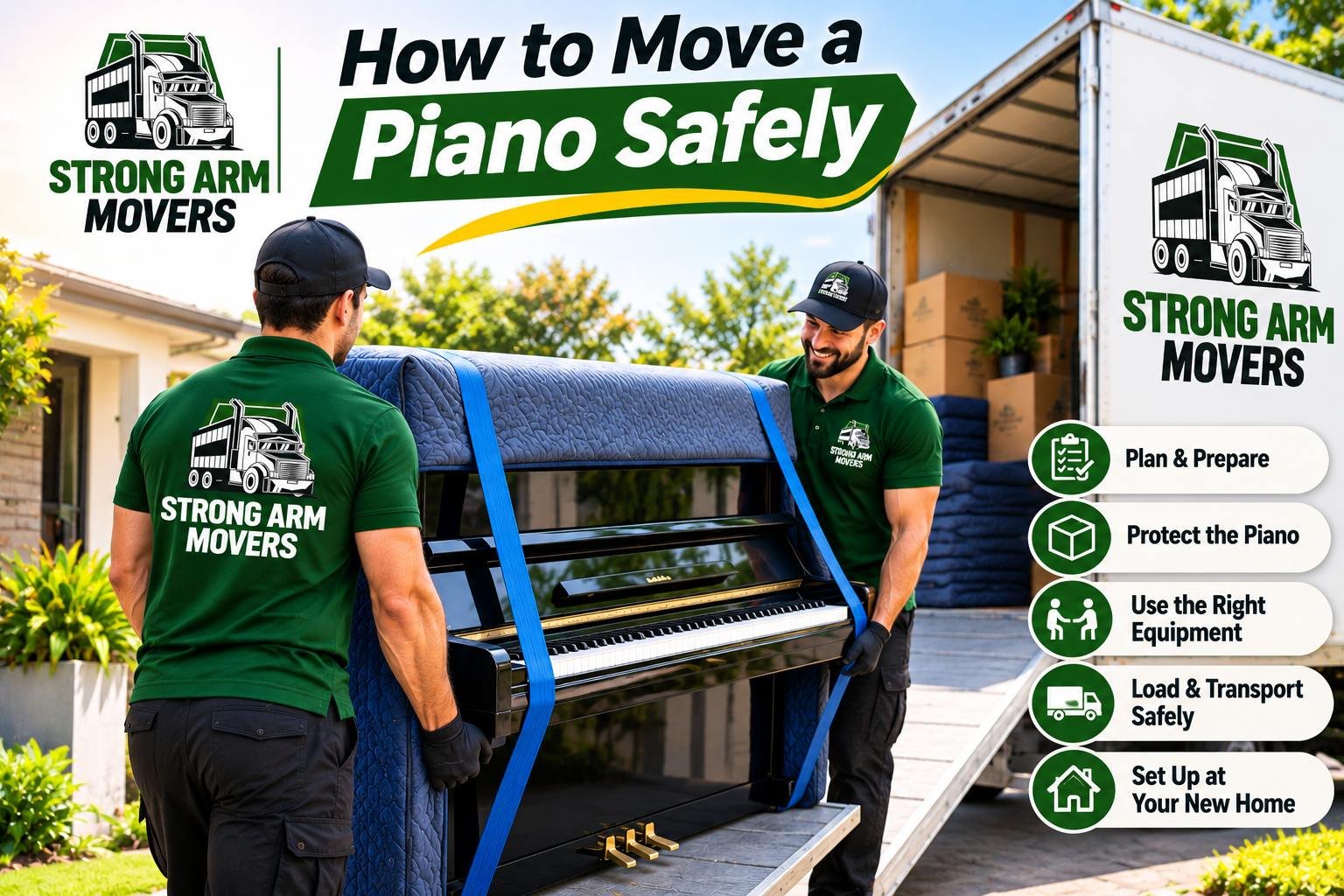
To move a piano safely you need the right gear (a piano board or heavy-duty dolly, straps and thick blankets), at least three or four strong helpers, a cleared path and a plan for every step, door and turn. Even a compact upright weighs more than 200 kg, so for stairs, grand pianos or long carries, professional piano movers are the safer choice.
Quick answer: Measure the path, protect the piano and the floor, keep the piano upright on its back edge on a dolly or board, never lift by the legs or lid, and strap it to the wall of the truck. Get a tuner in once it has settled in the new room.
Upright, grand or digital: why the type matters
The type of piano decides how heavy it is, how it’s carried and how much can go wrong. Here’s what you’re dealing with, using Yamaha’s published weights as a guide:
| Piano type | Typical weight | How it’s moved |
|---|---|---|
| Upright (e.g. Yamaha U1, U3) | About 228-246 kg | Stays upright, rolled on a dolly or board, tilted only slightly |
| Baby grand / small grand (e.g. Yamaha GB1K) | About 261 kg | Legs and pedal assembly removed, laid on its side on a piano board |
| Concert grand (e.g. Yamaha CFX) | About 485 kg | Specialist job only |
| Digital piano / keyboard | Much lighter | Boxed or wrapped like electronics; protect the screen and keys |
Older uprights can be heavier than modern ones, and antique pianos need a slower, more careful approach because the timber and joints may be fragile.
Can you move a piano yourself?
You can move a digital piano or a small upright on a flat, level path yourself if you have the gear and enough helpers. Stairs, grand pianos, tight turns or a long carry from the truck are where DIY moves go wrong, for the piano and for people’s backs.
Lifting, pushing and carrying heavy, awkward loads is a well-known cause of back injuries, sprains and strains, and Safe Work Australia’s guidance is to reduce manual handling by using mechanical aids. With a piano, a load that shifts suddenly on a step can’t be caught by hand.
What you need
- Piano board (skid) or heavy-duty four-wheel dolly rated for the weight.
- Lifting and ratchet straps to hold the piano to the board and later to the truck.
- Thick moving blankets and tape (tape goes on the blanket, never the timber).
- Floor protection: hardboard sheets or floor runners for timber, tiles and carpet.
- A ramp or tail-lift truck for loading.
- Gloves and closed shoes with good grip.
- Three to four people for an upright, more for a grand.
Step by step: preparing the piano
- Measure everything. Measure the piano, then every doorway, hallway, stair width and turn on the way out and in. A piano that clears a door straight may not clear the turn behind it.
- Clear the path. Move rugs, furniture and anything on the walls. Prop doors open.
- Close and lock the lid over the keys, or tape it shut over a blanket.
- For a grand: remove the music desk, then the lid, pedal lyre and legs, and bag every screw with its part.
- Wrap the piano fully in blankets and tape them in place.
- Get it onto the board or dolly with people at each end lifting together, knees bent, never by the legs, lid or pedals.
- Strap it to the board before it goes anywhere.
How do you move a piano up or down stairs?
Move a piano on stairs one step at a time on a piano board, with most of the crew on the downhill side taking the weight and one person guiding from above. Nobody should ever stand directly below a piano on stairs without being able to step clear.
- Lay board or sheeting over the steps if they’re polished timber or tiles.
- Stop and rest on landings, not halfway down a flight.
- Agree on calls before you start (“ready”, “step”, “stop”) so everyone moves together.
- For narrow, curved or long staircases, or a second-floor apartment, call professionals. That’s exactly the job where the right board, straps and crew size matter.
How to move a piano without scratching the floor
Never roll piano castors across a floor. Those small wheels are decorative on most pianos and will dig into timber and crack tiles. Put the piano on a dolly or board, lay hardboard or floor runners along the whole path, and cover door frames and corners with blankets.
Loading and securing a piano in a truck
Load a piano with a ramp or tail lift, then stand it against the front wall or side wall of the truck and strap it to the tie rails at two heights. Keep it upright if it’s an upright, and on its side on the board if it’s a grand.
- Pad between the piano and the truck wall.
- Don’t stack anything on top of it.
- Load it early so it sits against a wall, and pack mattresses or soft items around it so nothing shifts.
- Check the straps again before driving off.
After the move: settling and tuning
Pianos often drift slightly out of tune after a move because of changes in temperature and humidity, as well as the movement itself. Place it on an inside wall away from windows, heaters and air conditioners, let it settle in the room, then book a tuner.
Piano technicians suggest tuning a home piano at least once a year anyway, so many people time that tuning to fall after a move. Ask your tuner how long they’d like it to settle first.
When to call piano movers
Call professionals if any of these apply:
- Any stairs, especially more than a few steps
- A grand or baby grand piano
- An antique or sentimental piano
- Tight doorways, turns or a long carry from the truck
- An apartment move with a lift booking or loading dock
- An interstate move
- Not enough strong, experienced helpers
Our piano movers check access, stairs and doorways before moving day, wrap the piano fully, and use boards, straps, padding and lifting equipment to move it safely. For grand pianos, the legs and pedal assembly are removed for transport and put back on at the new home. We move pianos locally in Melbourne and Brisbane and interstate.
Before any piano move, check what’s covered if something goes wrong. Our moving insurance guide explains the main types of cover.